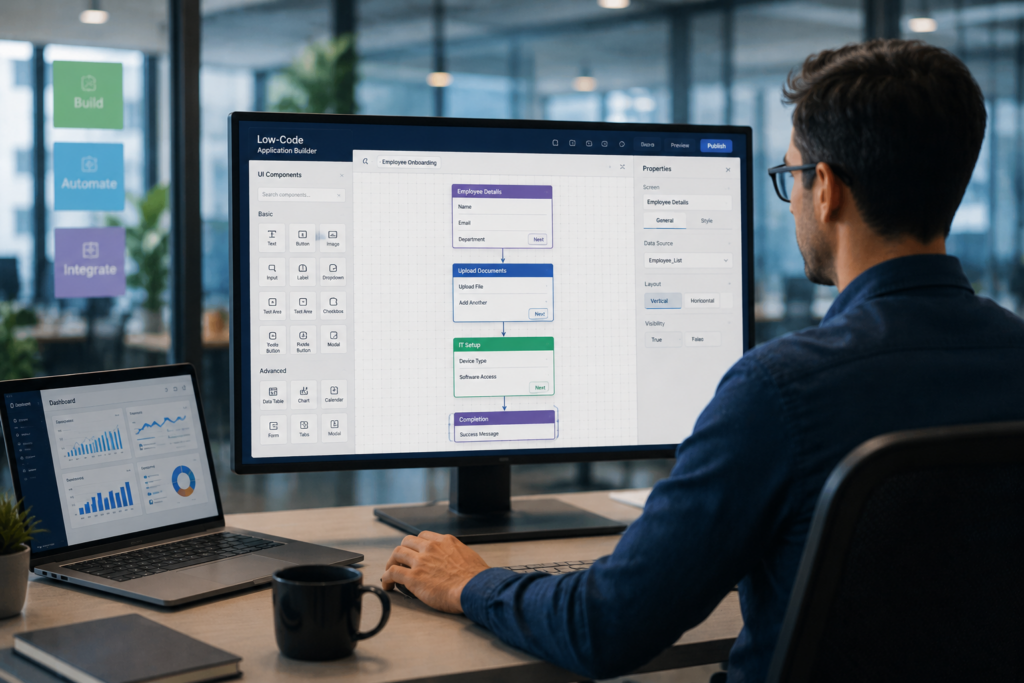

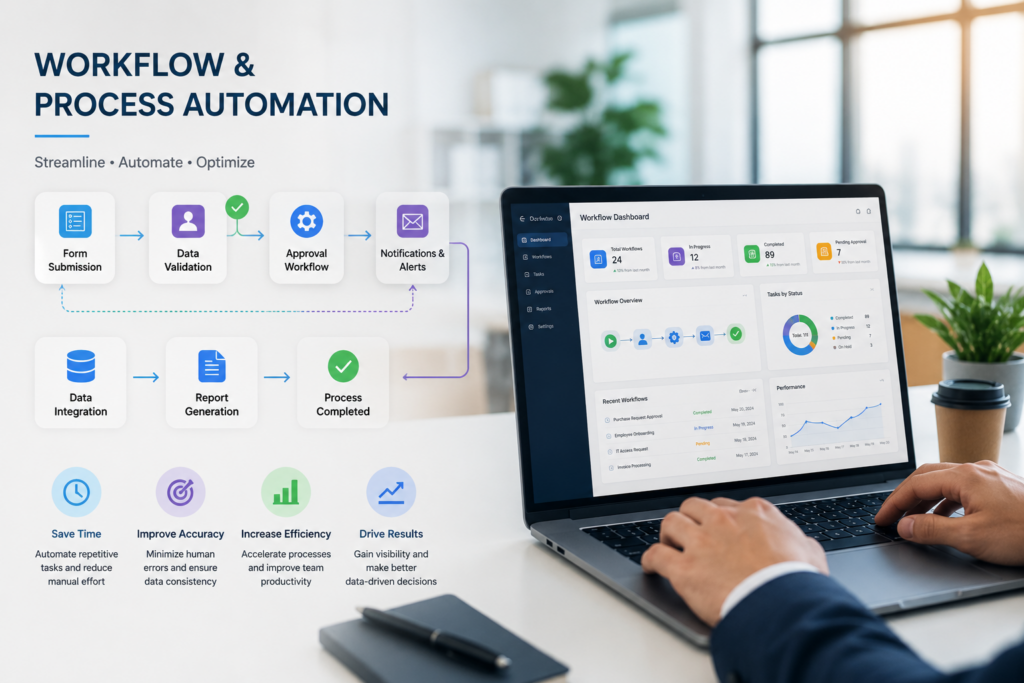
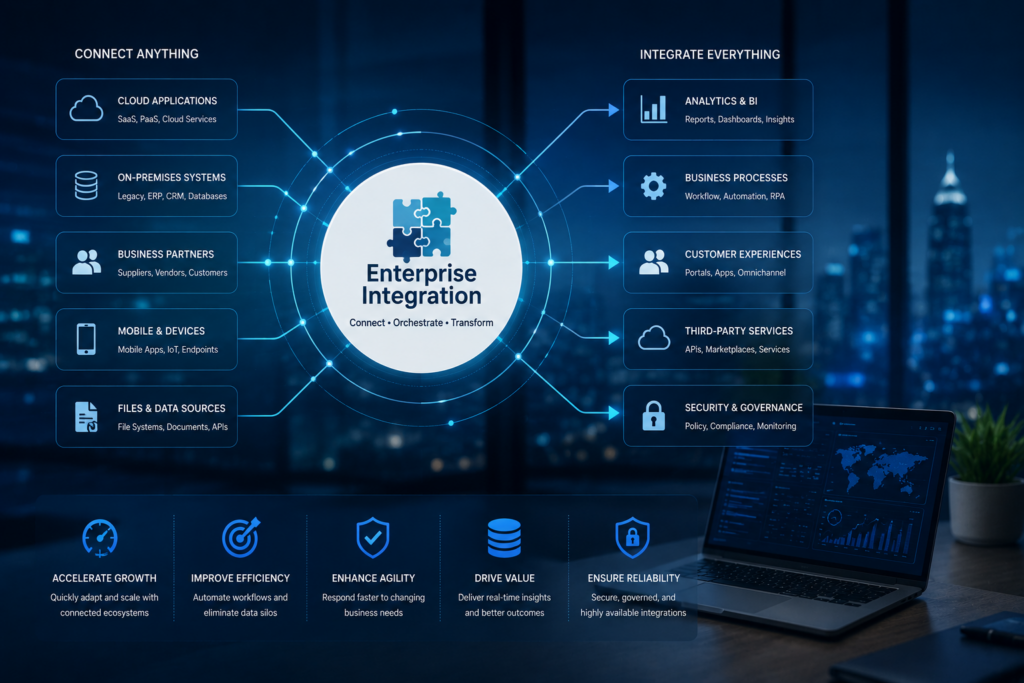

Low-code and no-code platforms are redefining how businesses build applications and automate processes. By minimizing manual coding and enabling rapid development, organizations can respond quickly to changing market demands.
Qruize empowers enterprises to leverage these platforms to streamline operations, improve customer experiences, and accelerate digital transformation with minimal complexity.
Industry analysts now expect low-code and no-code platforms to account for the large majority of new enterprise application development — a dramatic jump from a small minority just a few years ago.
Generative AI is fusing with low-code platforms: natural-language app generation, AI-suggested data models, and conversational refinement are becoming standard features rather than premium add-ons.
Most low-code projects stall the moment a requirement falls outside the platform’s drag-and-drop components usually within the first sprint. We build with that ceiling in mind from day one, layering AI-assisted generation on top of visual development and keeping pro-code extensibility available for whenever native components run out.
An approval chain that lives in someone’s inbox isn’t a process — it’s a bottleneck with a name. We digitize that end-to-end, with audit trails and status visibility for every workflow instance, not just the finished output, and pair it with robotic process automation, including our own QruizeMate platform, for the parts of a process that touch legacy systems with no usable API.
A low-code app that doesn’t talk to your ERP, CRM, or HRIS is just a faster way to create a new data island. We connect every app we build to the systems that actually run the business, using API-led and iPaaS-based integration patterns so data flows both ways instead of getting re-entered by hand.


Our architecture integrates Microsoft Power Platform components with Azure services to deliver end-to-end automation, data integrity, and intelligent analytics. It isdesigned for scalability, governance, and seamless interoperability across enterprise systems.

Power Apps delivers intuitive, role-based interfaces for request creation, approval, and tracking within a governed environment.
Power Automate orchestrates multi-level workflows with dynamic routing, SLA management and notifications
Dataverse and Azure SQL work together as the central data backbone, ensuring structured storage and high- performance analytics.
SharePoint & OneDrive maintain centralized repositories for attachments, workflow records, and compliance documentation.

Power BI provides real- time insights through interactive dashboards that highlight SLA performance and process efficiency.
Migrate existing BPM platform that is EOL to Power Apps. Automate and digitize approval workflows across departments using Microsoft PowerPlatform, integrated with Azure SQL and SharePoint for streamlined operations.
Unified and modernized fragmented approval and activity workflows using Microsoft Power Platform, integrated with enterprise data systems toimprove governance, visibility, and operational efficiency.